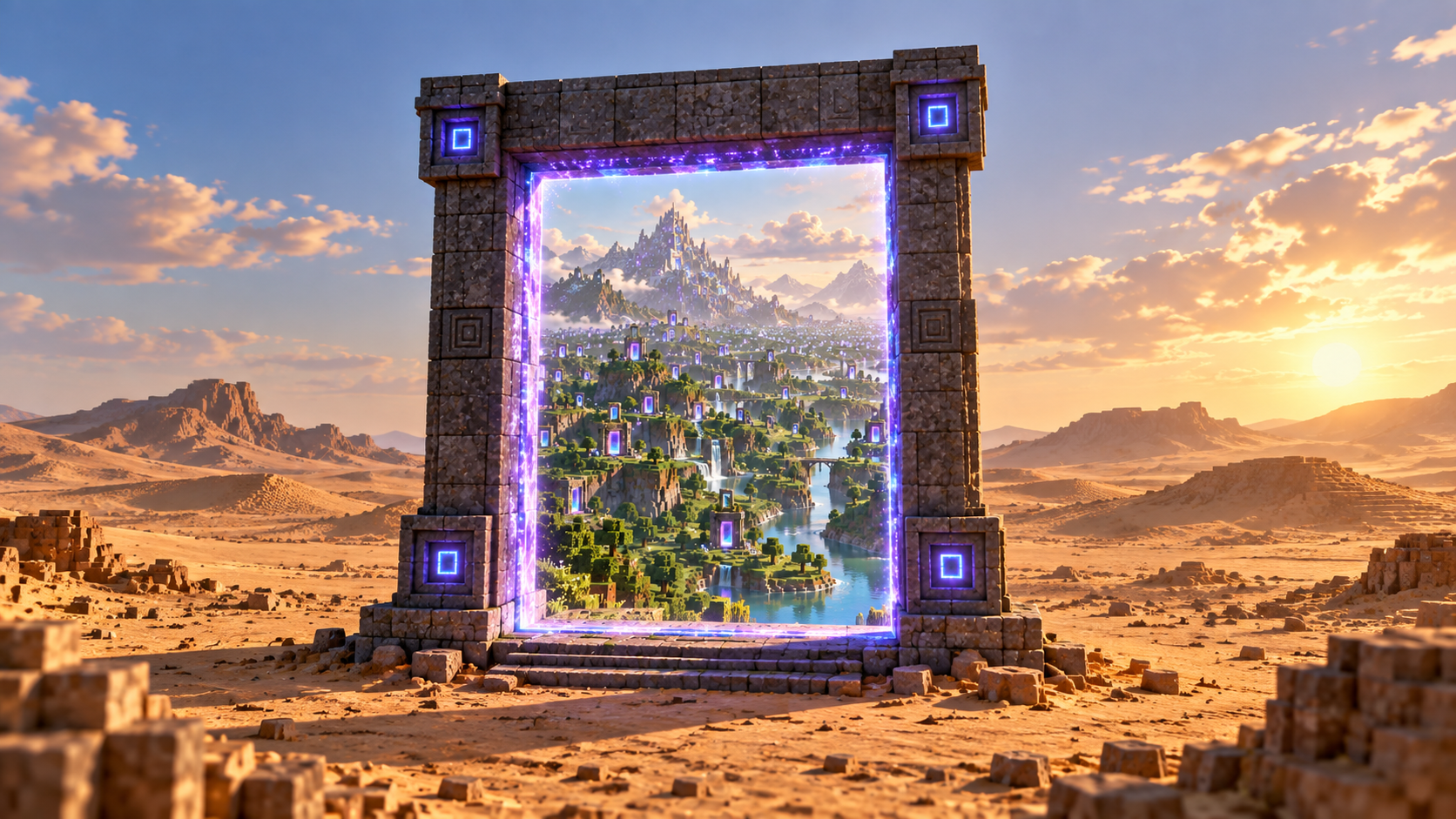
Neverland is an open protocol for interconnected game worlds created and evolved through conversations with AI agents.
Players use one identity across 2D, 3D, and text worlds, travel through portals, and carry NFTs whose appearance and abilities are defined by each world.
Creators ask agents to build environments, change gameplay, and create NPCs. Each world controls its own rules, permissions, and governance—including the option of autonomous agent administration.
Worlds collaborate to share audiences, recognize assets, and agree on rewards, allowing creators to benefit from the communities they attract.
A living world, built from modules.
Each world runs on a supervisor server. The supervisor manages connected players, permissions, persistent state, and the execution of multiple WebAssembly (WASM) modules. Those modules describe the world’s rules and the behavior of its NPCs.
Assets provide the world’s appearance and sound: models, textures, animations, and audio. The game client presents the world and its interface; the supervisor runs its authoritative simulation.
PLAYER / GAME CLIENTInterface, rendering, input
ARCHITECT AGENTCreates and revises the world Acts with granted permissions
↕ Input & live state · Requests & authorized updates ↕
Target architecture. Assets are resources, not executable WASM. Rendering belongs to the client; module execution and authoritative state belong to the supervisor.
The Architect changes the game itself.
Describe what you want. The Architect can revise everything from the interface and visual presentation to NPC behavior, physics, objectives, and world rules. It creates or updates modules and assets, then submits the changes to the supervisor. The supervisor checks authority and validates the update before installing it.
The Architect is an administrative client, not an unrestricted bypass around the world’s permissions. It can also create portals to other games when the applicable permissions allow it.
One portal. Two sets of conditions.
The source world can set conditions for using its portal, while the destination sets its own admission conditions. A player must satisfy both. For example, the source might require a completed quest, and the destination might require an invitation or a recognized NFT. These are possible rules, not mandatory platform requirements.
Interactive protocol illustration — toggle either condition to see how admission works. This does not connect to a live world.
→
A portal’s presence is not a guarantee of entry. If the destination revokes access, it rejects new arrivals even when the portal remains in the source world. After entry, the destination decides how to represent the player’s recognized assets and which abilities they provide.
What works today: a supervisor, a replaceable world WASM module, an Architect client, persistent state, and portal travel between our two hosted worlds. Multiple independent NPC modules, arbitrary interface changes, and the full two-sided portal policy are target capabilities, not completed PoC features.
From experiment to open worlds.
Our direction is established. We are now testing how it can work: what agents can build, how reliably worlds can evolve, and what it takes to connect them.
Experimental roadmap · Updated September 28, 2026 · Proposed milestones, not delivery commitments.
Already demonstrated
Two persistent multiplayer worlds with 2D and 3D views.
NEAR testnet wallet login and live shared state.
An Architect that changes game code and installs validated WASM updates.
Task tracking, compiler-error repair, restart persistence, and rollback support.
What we are testing now
Can an agent keep changing a growing world while preserving its earlier mechanics and saved state?
We need to measure behavior, reliability, latency, and cost—not just whether generated code compiles. The current 3D view still uses planar player movement.
01
Reliable world evolution
In progress
Change an existing world without losing it.
Current: In progress: mechanisms exist; reliability unmeasured.
Evidence needed: Repeated update, failure, restart, and recovery scenarios.
02
Your own world
Not implemented
Create a private world from a prompt.
Current: Not implemented.
Evidence needed: An end-to-end creator flow with enforced permissions.
03
Worlds with different rules
Partially demonstrated
Build distinct 2D and full 3D experiences.
Current: Partial: actions/entities exist; broad runtime not implemented.
Evidence needed: Different playable genres through the same versioned interfaces.
04
An open network of worlds
Partially demonstrated
Travel between independently hosted worlds.
Current: Partial: local portal demo only.
Evidence needed: Two operators and an independently implemented client.
05
Identity and assets across worlds
Partially demonstrated
Use an AA profile and NFTs under local world rules.
Current: Partial: single-wallet login only.
Evidence needed: Real NEAR testnet ownership and cross-world interpretation.
06
Creator collaborations
Not implemented
Sustain communities and execute agreed commercial terms.
Current: Not implemented.
Evidence needed: A measurable collaboration with reconciled payments.
07
Autonomous worlds and broader operation
Not implemented
Delegate administration to agents and grow the network.
Current: Not implemented.
Evidence needed: Enforced authority, bounded resource use, and operational recovery.
Next experiment: repeatedly evolve one persistent world, check the requested behavior, restart it, and continue editing. Then prove the smallest creator flow: prompt → private world → verified change → return after restart → deliberate publication.
The PoC is not yet a general game-creation platform. Full AA profiles, NFTs, private-world creation, and independent-server travel remain future work. “Millions of worlds” is a long-term direction, not a tested capacity claim.